Where to Buy a Genuine Silk Scarf in Sweden? Complete Guide
Guide to genuine silk scarves: learn to tell silk apart from satin and polyester, understand momme weight and silk twill, and find retailers that sell high-quality 100% silk.
Where can you buy a genuine silk scarf in Sweden? It's a question more and more people are asking, for good reason. Many scarves labelled "silk" turn out to contain polyester, viscose, or an unclear blend of both. Retailers put premium prices on materials that don't live up to their claims, and without the right tools it's hard to tell genuine quality apart from a well-made copy. It's easy to miss, but not if you know what to look for.
This guide gives you a concrete framework for how to verify authenticity with your own eyes, which Swedish retailers actually deliver 100% silk, what you should realistically expect to pay, and what you should verify before completing a purchase. There's a growing number of e-commerce options aimed at the Swedish market, but few specialise exclusively in premium Como silk. That difference matters, and you'll understand why if you keep reading.
What sets a genuine silk scarf apart from a copy
Genuinely premium silk differs from mass production on three concrete points:
- origin
- weaving technique
- edge finish
All three are visible in the product description at a serious silk retailer in Sweden. If information about any of them is missing, that's a warning sign.
Origin actually matters: Como silk and mulberry silk
Many of the world's finest silk scarves are made in Como in northern Italy, a region known for its silk craftsmanship and high quality. The region has a regulated craft tradition, controlled raw materials, and a standard of weaving and finishing not found in large-scale industrial production. The higher quality of Como silk comes primarily from careful weaving technique, meticulous finishing and developed craftsmanship rather than fibre length alone, factors that together give the scarf its characteristic sheen and drape.
A label reading "100% silk" tells you nothing about origin or material strength. It's a minimum requirement that all silk-labelled products must meet under EU textile legislation, not a quality promise in itself. The label you're looking for combines 100% silk with clear origin labelling, ideally specifying the region rather than just "Made in Italy".
Silk twill weaving and momme weight: what the numbers mean
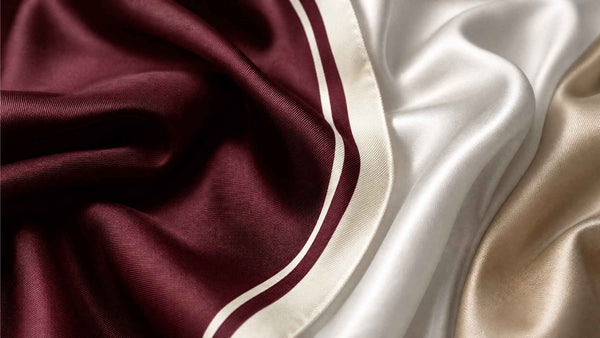
Silk twill is a diagonal weave pattern that gives the fabric its characteristic sheen, stability and natural drape. It's the weaving technique found in classic European silk scarves, and what separates a thin, easily creased fabric from a scarf that holds its shape over time. The weaving technique affects how light is reflected and how the scarf drapes around the shoulders and neck.
Momme weight, often abbreviated mm, indicates how heavy the fabric is per standard area. For thin silk scarves and neckerchiefs, 14 momme is often cited as an important benchmark for durability and shape retention, while heavier scarves can be 19 momme or more. Look for these specifications in the product description, not just "100% silk". A retailer that states momme weight takes the material seriously. For a deeper look at what higher momme weight (for example 22 momme) means for sheen and durability, you can read an explanation of 100% 22 momme mulberry silk.
Hand-rolled edges: the final quality test
Hand-rolled edges are time-consuming manual work where every edge is sewn by hand, one stitch at a time. It's the technique used on classic European luxury scarves and one of the surest signs of genuine skill and experience. The edge of a machine-made scarf is flat and uniform; a hand-rolled edge is slightly uneven, three-dimensional and hard to replicate with automated methods.
You can verify this with your own eyes: turn the scarf over and look at the back of the edge. A hand-rolled edge doesn't look perfect, and that's exactly what makes it genuine.
How to test if a scarf is really 100% silk
You don't need a lab to make a reasonable assessment. With a few simple methods at home, before or after purchase, you can form a solid impression.
Feel and sheen: the first quick test
Genuine silk feels cool on first contact with the skin and warms up quickly from your body heat. It glides without friction and has a lively sheen that shifts with the light, not a constant metallic gloss like polyester. Viscose imitates the feel better than polyester but gives itself away in use: it clings to the skin when you sweat and absorbs moisture differently from silk.
- Rub the fabric gently between your fingers. Genuine silk glides like water; synthetic materials feel static or slightly sticky.
- Hold the scarf up to a window and turn it slowly; the sheen should be subtle and shift with the light, not flash uniformly at every angle. If you want a technical explanation of the differences between various textiles, there's an accessible overview at Testex.
The burn test and what to look for on the label
Take a single thread from the seam allowance (the discreet edge on the inside), hold it with tweezers outdoors and bring a lit match close to it. Genuine silk smells like burnt hair or nails, leaves a soft grey ash that crumbles and self-extinguishes. Polyester melts into hard beads with a chemical, sweetish smell, and viscose burns quickly and evenly like paper, leaving a grey powder.
Check the label according to EU textile legislation: all textiles sold within the EU must carry full fibre labelling. If it's missing entirely, avoid the product. "100% silk" or "pure silk" is a minimum requirement; a trustworthy retailer also states country of origin and, ideally, weaving technique and momme weight in the product description.
Where can you buy a genuine silk scarf in Sweden?
Sweden has a small number of truly reliable retailers for scarves in 100% silk. Below they're ranked by degree of specialisation and transparency about origin.
ELOÈ: Como silk direct to the Swedish market
ELOÈ is a brand with a single, well-defined product focus: the silk scarf in its classic form, in 100% silk from Como. It's a narrow, highly specialised range, and that's intentional. Every scarf is woven in silk twill and finished with hand-rolled edges, the concrete quality markers you now know to look for.
What sets ELOÈ apart from generic fashion retailers is transparent communication about material and origin. You won't find vague product descriptions with "soft, luxurious fabric" here; you'll find precise specifications and a clear story about why Como silk is different. Through the concept "The Silk Edit", ELOÈ also offers style guides and care advice, making the purchase more complete than simply receiving a scarf in a package.
Other Swedish options: from niche boutiques to department stores
There are a number of other credible options on the Swedish market, each with a slightly different focus:
- Sjalbutiken.se: A large range in 100% mulberry silk with broad product variety and fast delivery. Good for anyone who wants plenty of options to choose from.
- Sidenselma.se: Markets itself as Scandinavia's largest silk range, from cushions to dressing gowns.
- NK: A reliable physical channel in Stockholm and Gothenburg for anyone who wants to see and feel the scarf before buying.
These options are credible for anyone looking for a broader range or who prefers shopping in a physical store. ELOÈ stands out with its specific focus on Como silk with Scandinavian design, documented weaving technique and craftsmanship quality.
Price range for genuine silk scarves in Sweden 2026
The price of a genuine silk scarf varies more than most people expect, and there's an explanation behind the differences that's worth knowing before you buy.
What do different sizes and quality levels cost?
A small silk neckerchief of around 50×50 cm in standard mulberry silk typically costs 200 to 500 SEK from Swedish retailers. A larger scarf at 70×200 cm in certified 100% silk falls in the range of 500 to 900 SEK, while premium-woven silk twill with hand-rolled edges usually lands between 900 and 1,500 SEK. Hand-woven pashmina in cashmere-and-silk blends often costs between 800 and 2,000 SEK depending on fibre content and country of manufacture.
Shipping is free at many Swedish silk retailers above a certain order amount, an amount that varies by retailer but is often around 450 to 595 SEK. Always check the terms before adding to your cart.
When it's worth paying more
The price difference between 300 SEK and 1,200 SEK reflects concrete quality choices: momme weight, fibre grade, manufacturing method and origin. A silk twill scarf with hand-rolled edges lasts for decades with the right care. A cheap copy loses its sheen after just a few uses and starts creasing permanently within the first season.
For gift purchases for special occasions, the difference is especially clear. A scarf in 100% silk with traceable origin and visible craftsmanship carries a stronger emotional value than a generic luxury package; it's an object with a story behind it.
Certifications and origin labelling: what to check
Certifications can seem overwhelming, but really you only need to keep track of two things.
OEKO-TEX STANDARD 100: what it actually guarantees
OEKO-TEX STANDARD 100 tests for over 1,000 harmful substances, including formaldehyde, heavy metals and azo dyes, in all components including thread and any accessories. It's not a quality certification in itself, but a health and safety certification guaranteeing the product is safe for skin contact. You can verify a certificate at oeko-tex.com/label-check using the product's certificate number.
The strongest combination to look for is OEKO-TEX STANDARD 100 plus clear origin labelling, ideally with the region specified (for example "Como, Italy" rather than just "Made in Italy"). Together, the two give you assurance on both health and origin.
Silk grade, origin labelling and what's missing from the legal requirement
Silk grade A, and especially 6A, denotes the longest fibres with the fewest defects and the highest sheen. Look for this in the product specification if available; it's a positive sign but not a legal requirement. EU textile legislation requires fibre labelling and origin labelling, but neither fibre grade nor weaving quality is part of the mandatory information; it's up to the retailer to communicate these voluntarily.
Retailers that transparently communicate momme weight, weaving technique and region of origin are by definition more trustworthy than those who settle for writing "100% silk" in the product description. Detailed product information is a concrete sign that the retailer takes its material seriously.
Care and return terms: what to check before you buy
The right care determines whether a silk scarf lasts a year or a decade. The right return terms determine whether you can shop with confidence.
Basic care to make the scarf last
Hand washing in lukewarm water with a mild detergent intended for wool or silk is the standard method. Avoid machine washing at high temperatures, spin cycles and tumble dryers. Dry the scarf flat on a towel, iron on low heat with a cloth in between, and store it folded or hung in a cotton bag. Silk needs to breathe and doesn't fare well in plastic bags.
Return terms and what a serious e-commerce retailer offers
At least 14 days' right of return applies under EU law for online purchases. Check whether the original packaging is required for a return and whether return shipping is covered by the retailer or by you as the customer. It's common for return shipping to be paid by the customer at Swedish niche retailers, but there are exceptions, and it's worth asking directly.
New as of June 2026, you also have the right, for online purchases, to get a response from a human when making a complaint, not only from a chatbot. This further strengthens your protection as a consumer.
How to make the right purchase: a summary
The framework is simple once you have it clear in your mind.
- Check origin, weaving technique and edges.
- Test with feel, the burn test and the label.
- Choose a silk retailer in Sweden that communicates transparently about material and origin.
Together, these steps take you from uncertainty to an informed purchase.
ELOÈ suits anyone who wants Como silk with documented quality: silk twill, hand-rolled edges and a clear origin from one of the world's most respected silk regions. If you want to shop more broadly, credible alternatives include Sjalbutiken.se and NK, depending on what you prioritise.
Where can you buy a genuine silk scarf in Sweden? The answer is: from a retailer whose content you actually know. That's the only deal worth making. Explore silk scarves from ELOÈ
Gå med i The Silk Edit
Fritt att läsa. Medlemskap ger nya guider först och 10% på första köpet.